
SEO and Content Marketing: How They Differ & Why You Need Both in 2026
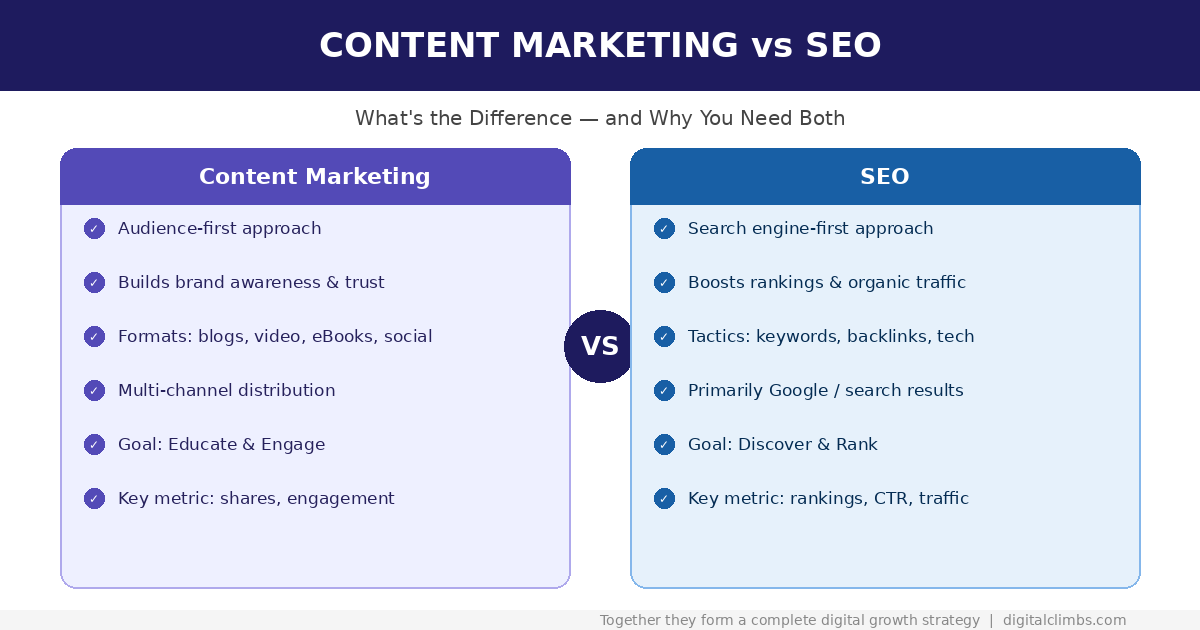
Content marketing and SEO are two of the most used terms in digital marketing, and two of the most frequently conflated. Ask ten marketers to define the relationship between them and you’ll get ten different answers, ranging from ‘they’re the same thing’ to ‘they’re completely separate disciplines’.
The reality is more nuanced, and getting it wrong has real consequences. Companies that treat them as identical end up with content that doesn’t rank. Companies that treat them as separate end up with SEO that doesn’t convert. The teams that win at organic growth understand how the two disciplines interact, and build strategies that leverage both deliberately.
This guide breaks down exactly what content marketing and SEO each involve, where they overlap, where they diverge, and how to build an integrated approach that drives both traffic and pipeline.
Where Content Marketing and SEO Overlap
The overlap is substantial, which is why the two disciplines are so frequently confused.
1. Both require keyword research
Any content marketing strategy targeting organic search needs keyword research to identify what topics people are actually searching for, in what volume, and with what intent. Keyword research is the bridge between content marketing’s audience-first thinking and SEO’s search-data-driven approach.
2. Both require high-quality content
Google’s ranking algorithm increasingly rewards content that demonstrates expertise, experience, authority, and trustworthiness (E-E-A-T). Creating content that genuinely helps readers, rather than content that just hits keyword density targets, is both good content marketing and good SEO.
3. Both benefit from link building
Great content marketing earns links naturally, other sites reference your research, cite your guides, or share your tools. Link building is an SEO discipline, but content quality is what makes it possible at scale. The two are inseparable in a mature organic growth strategy.
4. Both measure success through traffic and engagement
Organic traffic, time on page, scroll depth, and conversion rate are metrics that both content marketers and SEOs track. The overlap in measurement reflects the overlap in objectives.
Where Content Marketing and SEO Diverge
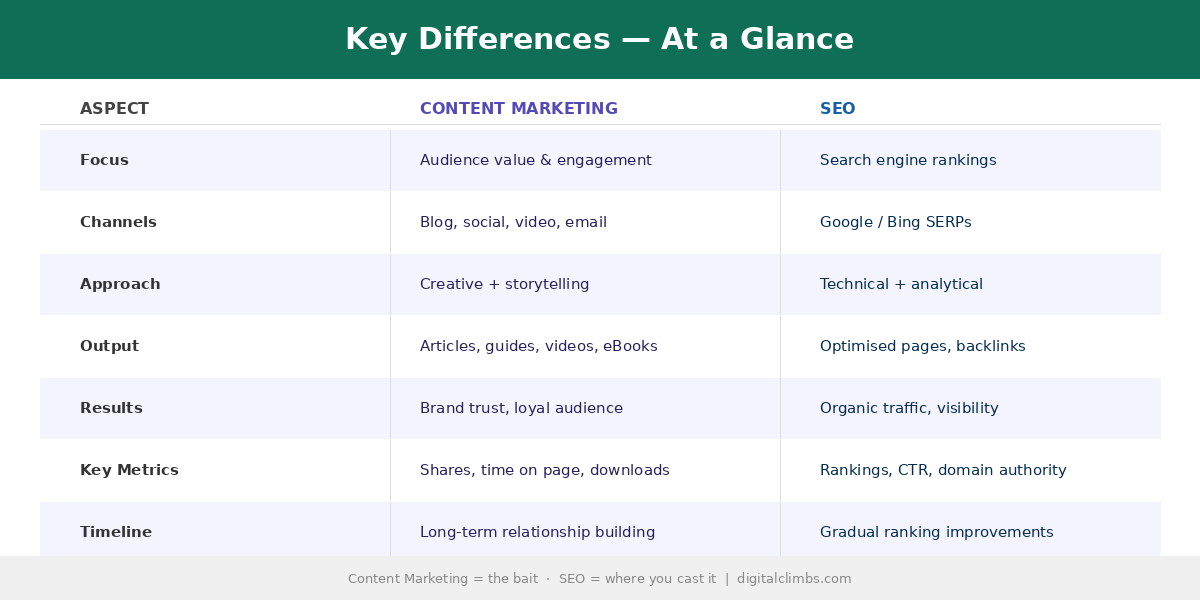
1. SEO is channel-specific; content marketing is channel-agnostic
SEO exists specifically in the context of search engines. Content marketing extends to every channel where content is published and distributed. A podcast episode is content marketing, it’s not SEO. A Twitter thread is content marketing, it’s not SEO. SEO is a subset of the content marketing universe, not a synonym for it.
2. SEO is driven by search data; content marketing is driven by audience insight
The starting point for SEO is what people are searching for: search volume, keyword difficulty, and search intent. The starting point for content marketing is who your audience is and what problems they have, which may or may not align perfectly with search demand. Both inputs matter, but they come from different places.
3. Content marketing includes non-search content
Thought leadership written for a LinkedIn audience, sales decks, customer onboarding guides, and event presentations are all content marketing. None of them are SEO. A content marketing strategy that ignores these touchpoints in favour of pure search optimisation is leaving significant audience development opportunities on the table.
4. SEO has more technical dependencies
Content marketing can succeed without touching a line of code. SEO cannot. Technical SEO, crawl optimisation, page speed, structured data, hreflang, canonicalisation, requires technical implementation that content marketing strategy alone can’t address.
Content Marketing + SEO: Why You Need Both
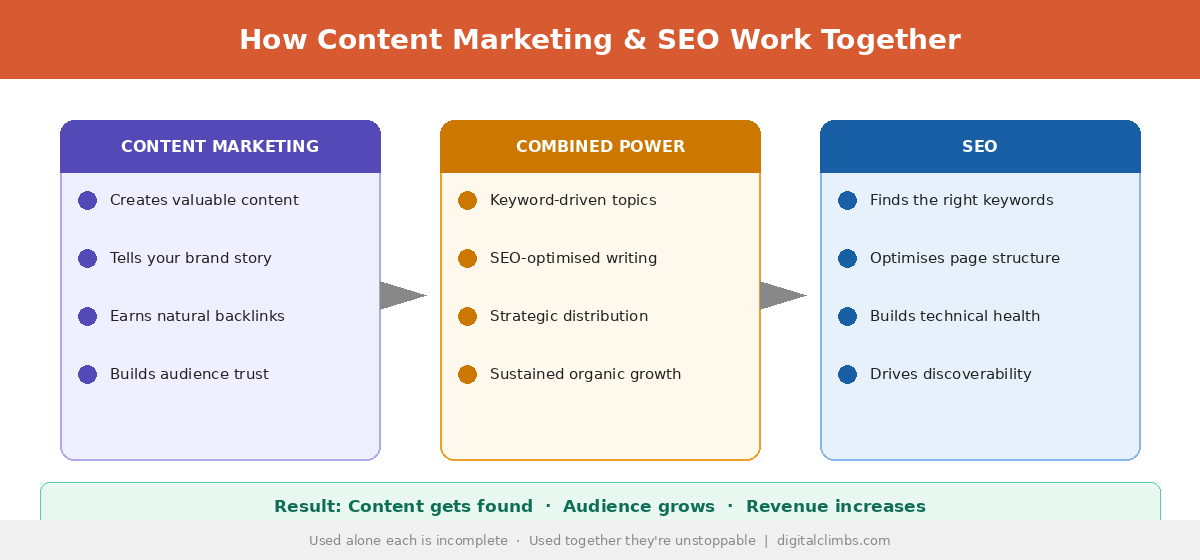
The most effective organic growth programs treat content marketing and SEO as complementary, integrated disciplines, not competing priorities.
1. SEO without content marketing produces thin, unconvincing pages
An SEO strategy that focuses purely on keyword targeting without genuine content quality creates pages that might rank initially but don’t build brand trust, earn links, or convert readers into customers.
Google’s quality signals increasingly penalise thin content that satisfies keyword intent without providing real value.
2. Content marketing without SEO produces invisible content
Brilliant content that isn’t optimised for search doesn’t rank. It might perform on social media or in email, but it misses the compounding, long-term organic traffic that makes content marketing one of the highest-ROI channels in B2B marketing.
The most common content marketing mistake is investing in content production without the SEO infrastructure to make it discoverable.
3. Together they create compounding organic growth
When you combine keyword-led content strategy with genuine content quality, technical SEO foundations, and a deliberate link building program, you get something that neither discipline achieves alone:
Compounding organic traffic that grows month over month without proportionally increasing investment. This is the organic flywheel that the best-performing SaaS and B2B companies have built.
How to Build an Integrated Content Marketing and SEO Strategy
Step 1: Start with audience and keyword research together
Map your ideal customer profile to their search behaviour. What problems do they have? What do they search when they’re trying to solve those problems? Where does search intent align with your content marketing objectives? This intersection is where your content strategy should live.
Step 2: Build a content architecture around topic clusters
Group your target keywords into topic clusters, a hub page for the main topic with supporting posts for related subtopics. This structure signals topical authority to Google and creates a natural internal linking architecture that distributes link equity across your content ecosystem.
Step 3: Produce content that earns links, not just ranks
Create content that other sites will want to reference, original research, comprehensive guides, unique data, and genuinely useful tools. Content that earns links builds the off-page authority that makes all of your SEO work more effective over time.
Step 4: Distribute content across channels with SEO as the foundation
Repurpose your top-performing blog content into LinkedIn posts, email newsletters, podcast episodes, and social content. SEO-optimised long-form content is the anchor; distribution across channels extends its reach and drives additional traffic back to the source.
Step 5: Measure both content and SEO metrics
Track organic traffic, keyword rankings, and referring domains as SEO metrics. Track engagement rate, time on page, and content-attributed pipeline as content marketing metrics. The full picture requires both.
Final Thoughts
The content marketing vs SEO framing is a false dichotomy. The question isn’t which one to choose, it’s how to make them work together. SEO tells you what to create and who’s searching for it.
Content marketing tells you how to create it in a way that genuinely serves your audience. Link building amplifies the authority of what you publish. Together, they’re the engine behind every high-performing organic growth program.
The companies winning at organic growth in 2026 aren’t choosing between content marketing and SEO.
They’re building integrated programs where keyword strategy, content quality, and link acquisition reinforce each other, and they’re reaping the compounding returns that come with it.